

How to develop a growth mindset
Updated: May 8
Ever feel like you want to be perfect at something right now? A sport? A character trait? A talent? A mindset? Perhaps you are trying but it feels like it is so hard and taking to long? (Please note, all of our classrooms are designed for families with preteens, teens, and younger kids to be read together. We recommend screensharing to your TV.)

All of our thoughts travel on something called neural pathways. Every time you think a thought it creates a neural pathway and when you think the same thought again it widens the neural pathway. Think of that like a little road in your brain, or a big highway in your brain. Our brain is wired to use the least amount of energy to come to a decision. So our brains often want to travel the biggest, and widest route that gets somewhere the fastest. We have mindsets, which in neurology is a six-lane freeway.

But we can change our mindsets, by changing the path we take in our brain. When we think of changing our mindsets we can think of Romans 12:2 which is “Do not conform to the pattern of this world, but be transformed by the renewing of your mind.” Growth minded people look for new pathways and are not afraid to be off the normal path. If you can actually develop a new neural pathway thought, for 40 days, you create a new mindset.

Developing a growth mindset could be summarized as the ability to not shut down when a path seems to be reaching a dead end. You probably have heard someone in your family a few times say, "This is too hard," or "I quit." Those are great examples of our brain not wanting to push through the dead end. Think of it like going off the hiking trail, and into new, unmarked territory, pushing your way through the trees and bushes; if you take the time to "hack your way through a new trail in the forest" you can create a new neural pathway in your brain. The more you travel it, the easier it becomes, and soon, after some time, you developed a new way of doings things, or a new mindset. You become a problem-solver. This does not mean that you have to do hard things every moment, this just means that when regular life gets hard, and it will, you have the ability to move past any obstacle by challenging your brain's desire to go back to easy. If you only stay in your comfort zone, you will not grow.

You can literally change the way you see the world, change the way you think about your problems, and change your view by looking for the adventure that comes from getting off the comfortable road in your mind. We will explore numerous tools that aid in cultivating a growth mindset.
Here is a great start up view for kids on what it takes to develop a growth mindset:
You start by recognizing why you want to grow. I love this quote by Carol Tuttle:
"In order to know love, we had to create hate; in order to know good, we had to create evil; in order to know joy, we had to create pain. It is only through experiencing these contrasts that we can fully realize who we really are. In order to experience who we really are, we have had to experience who we are not. We are all pieces of God, just waiting to be awakened and fully realized." Contrast helps us see. And we have to expect it in life. When we expect to fail, expect to make mistakes, expect to see dead ends...we will bravely pioneer new ways of making life beautiful for others around us. Suddenly new things become the catapult for more opportunity in life. This does not come from spending time in the comfort zone.

Gratitude is basically your cheat code for surviving life's chaos. Here's the wild part — every time you genuinely feel grateful, your brain literally rewires itself. Like, new connections form between your memory center and your reward center in real time. Your brain is out here doing construction work while you're just vibing. Most people treat gratitude like a mood — something that shows up when things go right. But intentional gratitude? That's different. Science shows it actually builds neural pathways that reconstruct themselves on the fly. Your brain can learn to route positive experiences through your higher thinking instead of letting them vanish like a Snapchat story. In one study, people who practiced gratitude could voluntarily pull up positive memories with increasing ease. Basically, you can train yourself to have better mental reception for the good stuff.
Here's the thing though — humans forget embarrassingly fast. And forgetfulness is the opposite of gratitude. When you forget all the good that came from the hard stuff, you stay stuck playing the victim of your own story. That's not the plot twist you want. But when you actually remember the good? Your brain starts collecting evidence that life has real, meaningful moments in it. You become biased toward noticing what's working. The victim mentality is genuinely one of the weakest ways to move through life — and your brain is capable of so much more than that. Check out this diagram of what gratitude does:
From The Curious Tales Twitter:

Be grateful for what you are learning. It is a part of why you are on Earth! Remember, the people around you are not perfect. You can learn from good examples, and you can learn from bad examples. You can learn from wise people, and you can learn from the mistakes of people. Be grateful for all the hard that comes your way. What doesn't kill you makes you stronger. You can access your inner wisdom, light and love from God, deep inside you no matter what your circumstances are. God is letting you learn something from every challenge you face. He never allows you to face a challenge you can not conquer. But you have to be teachable. We call this humility and meekness in religion. It is allowing someone else to share an idea that you are open to. The highest form of meekness is quiet, Christ-centered strength—humble, teachable, and guided by trust in God rather than self. When you are willing to let go of your pride, and absorb the wisdom from outside of yourself (especially and mostly from God), you are experiencing a growth mindset. In the scriptures it is called a "broken heart" and "contrite spirit." Something that is broken is open... open to new ideas, open to feedback, open to learning something. It is not hardened and stiff and unteachable. Pride is something that comes when we dwell in our ego state, a close-minded state of fear and scarcity.
One of the ways we reach a dead end in our brain, is when we spend too much time in our ego state. Our ego state wants to appear perfect, powerful, and strong to others. We don't want people to know when we fail. When we step into ego, we can not learn and grow. When we are in a growth mindset, we are not afraid of the opposites in life. We learn from our mistakes. One of the contrasts in life we need to identify is that of living in our true identity verses living in our false identity or our ego. Your true identity is the wise owl inside of you, your calm center. When you operate from this quiet captain part of you, you can thrive with a growth mindset. Which side do you like to operate from? Your vulnerable, faithful, open side, or your prideful, fearful, ego side. We each have these two parts inside of us. The trick is to flip back into your quiet captain as soon as you notice you slip out of it. How do you do this? You start by learning what ego feels like. Check these lists here and see which state your mind is in:
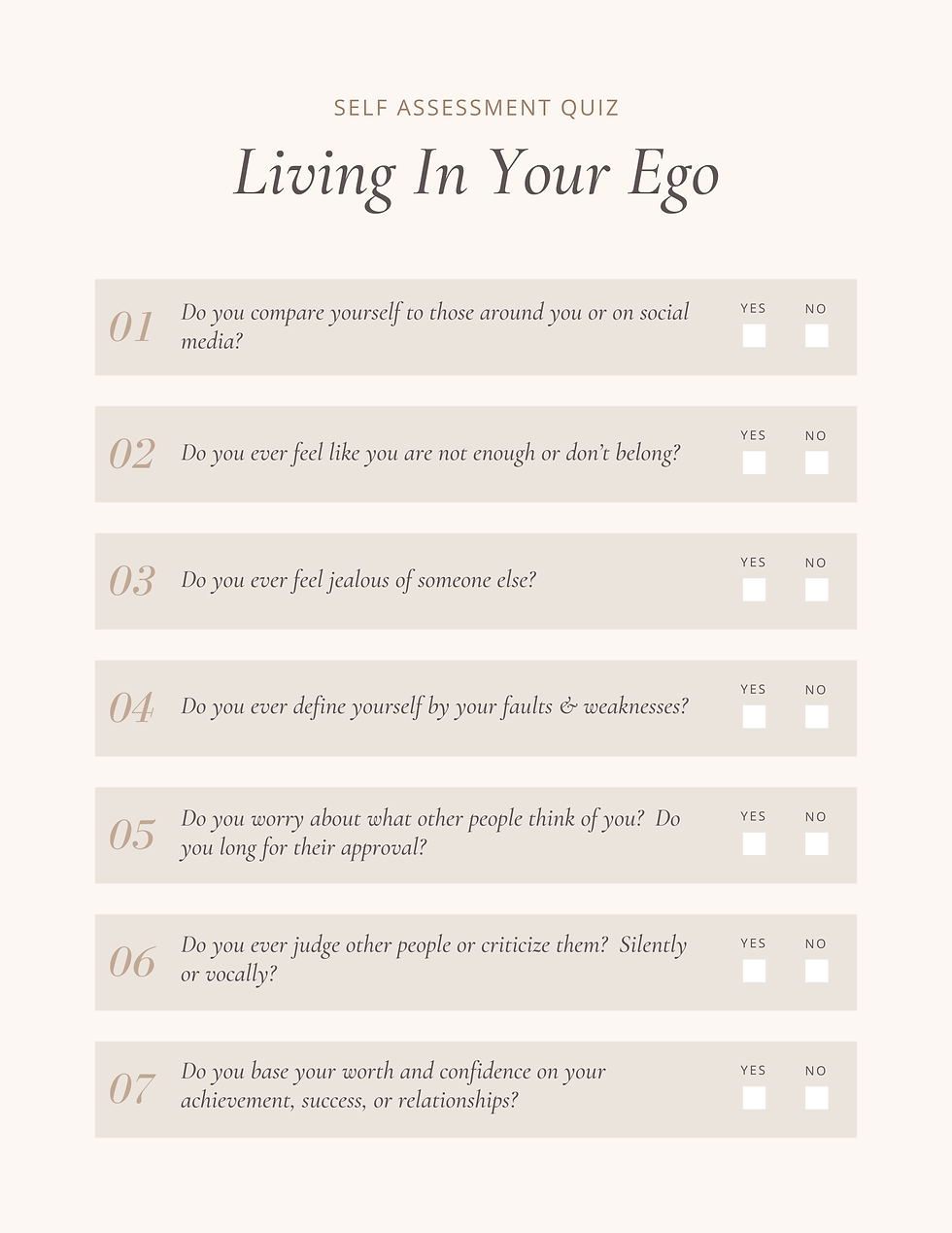

Let's talk about ego — and why some people can't stop feeding it.
Some people crave attention and validation like it's oxygen. And honestly? It's not entirely their fault. A lot of it traces back to childhood — how they were praised, how often, and how much they started to depend on it.
Here's the wild part: every single one of us carries some version of the story "I'm not enough" or "I'm not really loved."Nobody gets perfect love in this life. Nobody. So we all have a choice — use that as an excuse to live in ego, or use it as a reason to drop it.
Now here's where the science gets interesting.
Dr. Becky Bailey explains that kids don't develop the ability to regulate their own emotions until around age seven. Before that? They literally borrow it from the adults around them. However the adults in your life responded to your big feelings — that became the voice in your head. The way they talked to you became the way you talk to yourself.
Read that again.

So if that inner voice is harsh, dismissive, or never quite satisfied — it didn't come from nowhere. It came from somewhere. And here's the good news: you can rewrite it. Your brain is capable of building new roads. Old stories don't have to be permanent residents.
The most powerful person we've found for helping with that rewrite? Jesus Christ.
We can flip the switch in our mindset. We can take a different road in our brain and the first step is to recognize if you are in hanging in ego, and then take a breath. Breath calms you down and helps you access your calm center. There is a whole bunch of science around just relaxing your nervous system. It can be as simple as gratitude, breathing, and stillness. To be fearless, you have to be okay with mistakes. Just find ways to recenter and regroup for the next challenge. That is how you break pride and ego inside yourself. Humility is clear-eyed dependence on God—recognizing the truth about ourselves, receiving grace freely, and growing through Christ’s strength rather than pride. Want to grow and become a powerful wise sage? Become more humble. Growth minded people live in abundance, faith, love, charity, agency, understanding, openness, empathy, commitment, surrender, infinite possibility, non-judgment, courage, and course correction. Ego minded people live in scarcity, frantic energy, force, manipulation, shame, anxiety, hopelessness, deception, distraction, resistance, neediness, and doubt. Guess what, it takes time to learn all of this. Even growing takes growth. Nobody starts out perfect at any of this!
We don't discover humility by thinking less of ourselves; we discover humility by thinking less about ourselves. -Dieter Uchtdorf
Want to make new friends? Cool. But first, accept this: you might get rejected.
Someone might say no. Someone might not vibe with you. You might have to try a completely different approach. And that's fine — because at least you tried.
Here's where mindset splits everything in two.
A growth mindset girl thinks: "What can I learn from this? What kind of friends do I actually want?"
A fixed mindset girl thinks: "I'm just not someone who makes friends. I didn't like them anyway."
One opens a door. One is a dead end.
The problem is, when rejection hits early — when you're told you're wrong, left out, or not enough — it's really tempting to just... shut down. To stop trying. To protect yourself by never putting yourself out there again.
But growth-mindset people do something different. They expect rejection. They plan on making mistakes. They're playing the long game, and they know slow starts are part of it.
There was an NBA player who ripped a muscle — the kind of injury that takes a full year to recover from. In that moment, he thanked God. He didn't call it a failure. He called it a recovery period.
Another guy broke his arm right before one of the biggest moments of his life. His first thought wasn't anger or self-pity. It was genuinely: "What can I learn today?"
No pillow throwing. No cursing the universe. Just... openness.
That's a trained mindset. And you can train yours too.
Everything you go through has the potential to grow you — if you let it.
Growth means power. So let it hurt, let it teach, and keep going.
There is one reason that some people can fall into an ego mindset. They crave honor and attention or maybe even depend on it to feed their ego. This may have to do with how they were praised or how they are praised and how dependent they may have become on that praise. All of us have internal thoughts from our childhood that we are unloved, or not enough. None of us ever receive perfect love in this life, so we can use that as an excuse to live in our ego, or to abandon it.
But behold, Jesus Christ hath shown you unto me, and I know your doing. And I know that ye do walk in the pride of your hearts; and there are none save a few only who do not lift themselves up in the pride of their hearts, unto the wearing of very fine apparel, unto envying, and strifes, and malice, and persecutions, and all manner of iniquities; and your churches, yea, even every one, have become polluted because of the pride of your hearts. -Moroni
If we have pride, we are in ego. If we are in ego, we are trying so hard to protect the story we tell ourselves in our head that is not true. We are not focusing on God's love for us. We are craving validation from the world. We are forgetting the good that encompasses our lives. We should seek praise from God more than from others. We should be open to feedback, while praising ourselves for trying. That is one form of gratitude that keeps you growing.
Praise is something that can really affect our internal beliefs. Some of us grew up on too much praise, others not enough. If your future child builds a sand castle, and you say "that is the best sand castle I have ever seen" when the sand castle looks small and uneven with hardly any effort, you are not encouraging a growth mindset. A better thing to say is, "way to inititate creation" or "way to use your work ethic." When you tell a child they are the best, amazing, the prettiest, the smartest, you are telling them they don't have more to learn and grow from. They will operate in ego. This is why so many stumble in the real world when mom is not around; resilience comes from rewarding effort and curiosity, not perfection. I assure you, this intentional praise doesn't come naturally, it takes focus, which is why I am learning it still myself. This video was very helpful on the correct type of praise:
At times, we feel inspired to learn new skills but anticipate mastering them immediately. Many individuals are confident in their ability to learn, yet they think they can achieve it all in a single day. Some are driven by the desire for recognition or admiration. Seeking attention brings a bucket full of pride. Love is not something we earn, it is something we give. And if we think it is something we earn, than we are chasing something that can never satisfy. Because that is not even what love is. Love is a law, not a reward. Love is action, and if you keep this mindset you will stay out of ego. You will grow when you submit your will to God's will by taking time to learn things that bless other people. However, many believe that love is praise because receiving it feels good. Many people fear feedback and crave honor. They often think that validation from others will fulfill their longing for love. This is toxic perfectionism. The love we should crave, is the love from God. The void in our hearts gets filled by God because he turns us to focus on loving others, rather than being dependent on praise from the world around you. Growth minded people are outward focused.
The definition of perfectionism:
A personality trait where an individual aims for flawlessness and establishes extremely high performance standards, often coupled with overly critical self-assessments and worries about how others evaluate them. This is part of an ego state of mind.

The problem with perfectionism, is nobody on this earth can be perfect. In order to have a growth mindset, we must avoid the troublesome belief that sounds like this: " I am bad, unclean, not good enough, and beyond hope." Or “I am the best, I am the top, and I don’t need coaching.” These are all problems of living in our false identity, our natural man self, our ego.
Another thing that gets in the way of a growth mindset is scarcity; the never-enough problem.
Never good enough
Never perfect enough
Never thing enough
Never powerful enough
Never successful enough
Never certain enough
Never safe enough
Lynne Twist writes about scarcity as being the "the great lie."
"For me, and for many of us, our first waking thought of the day is "I didn't get enough sleep." The next one is "I don't have enough time." Whether true or not, that thought of not enough occurs to us automatically before we even think to question or examine it. We spend most of the hours and the days of our lives hearing, explaining, complaining, or worrying about what we don't have enough of...before we even sit up in bed, before our feet touch the floor, we're already inadequate, already behind, already losing, already lacking something. And by the time we go to bed at night, our minds are racing with a litany of what we didn't get done, that day...This internal condition of scarcity, this mind-set of scarcity, lives at the very heart of our jealousies, our greed, our prejudice, and our arguments with life."
To get out of scarcity, we have to switch the flip and move into an abundance mindset.
Being abundant does not mean you are just rich with lots of money. It means you believe there are many possibilities to learn and grow. It means you are open to possibility, open to challenging your thoughts, open to receiving new insights, open to being vulnerable about your fears, and open to the idea that there are new ways of doing things. An abundance mindset is a belief that there are plentiful resources, opportunities, and success available for everyone, contrasting with a scarcity mindset that sees them as limited. We start by being okay with failing, because it is always a part of the equation. And then we gratefully realize we have a million more opportunities to try again, see it from a new angle, and get 1% better next time. Gratitude for the opportunity to learn pushes you to try again, learn again, and build the resilience to finally catch on. The moment you become a victim, which is the opposite of grateful, is the moment you stop learning. Quit becomes your middle name.
Want to feel less stressed about where you're at? Look further out. You have years. Decades. Honestly — eternity. Whatever you're trying to build, you have more time than your anxious brain is currently telling you. Here's the thing: time is kind of an illusion. Humans get locked into it, obsessed with it, panicked by it. We become near-sighted — fixated on what's not done yet instead of what's actually growing. But studies actually show that when you stopobsessing over time, that's when inspiration tends to show up. Your best ideas don't come when you're frantically racing a clock. You're not behind. You're not losing. You're learning.
"By small and simple things are great things brought to pass." — that's scripture, and it's also just true. Why are we always sprinting toward tomorrow like today doesn't count?
Usually that urgency comes from not appreciating the tiny wins. So celebrate one step forward. And yes — celebrate the two steps back too. Every single step is building something, even the ones that hurt. But if you fight every setback with anger and resistance, you'll end up further back than the setback ever put you.
Look for the lesson in what's happening. It's always there — sitting quietly in the corner, waiting for you to notice it. A growth mindset isn't just optimism. It's the genuine belief that everything — everything — is teaching you something useful.
Breathe. You've got time.
People with a growth mindset:
See challenges as opportunities to learn
View mistakes as part of growth, not failure
Believe effort strengthens ability
Learn from feedback instead of feeling threatened by it
Stay resilient when progress is slow
The opposite is a fixed mindset that believes abilities are unchangeable, often resulting in the avoidance of challenges and a tendency to give up quickly. Fixed mindsets stem from the fear of not being praised or from making mistakes and failing.
At its core, a growth mindset is about believing you can become more than you are right now through consistent learning and effort (and forgiveness by a loving God). If it is making a new friend, than we have to believe there is something inside of us that can change, rather than waiting for the friends around us to change.

The goal is to be teachable in every stage of life. If there is a lack of confidence in your ability to grow, know that you are never beyond hope! God and the fresh starts he offers are ours every day, any time! He never expected us to become perfect in this life, he just expects effort. Never underestimate the power of prayer in your every day activity.
When you start to desire getting better at something, or learning something, especially when it comes to building your character, you are in a growth mindset. You may even get hungry enough to know everything all at once or become something all at once. This is where we have to be careful, because we may be stepping back into scarcity or "not enough time." You might even think you are the master of this new idea and there is no more to learn. You get so much momentum and then when things are not perfect, you realize you have a long ways to go to perfect that new skill or trait. This is where you must remember that good things grow slow. That is the beauty of mercy. We must remember that we are not done learning anything! There is always more to learn about everything! God nows what it is like to be human, he understands our sometimes "scarcity" that we feel. We must remember we have a merciful God who wants to help guide us along the way. He is patient and kind when we admit our mistakes to him and try again.
Remember the power of yet.
" I am not perfect at this ________ yet, but I am committed to becoming it."

We must steer clear of the conviction that we have full knowledge of how our life ought to be and will unfold, and that we are in complete control. Being so certain about how our life will turn out, may hold us back from being open to ongoing personal revelation from the Lord that can shift the direction of our life—even in a moment, moving us away from our destination and even away from our companions and neighbors.

One trick for having a growth mindset is to not think that your choice is between path A or path B only. When you are stuck, or need to make a decision about something, remember that sometimes you just have to have faith that option C will come to light. You just have to take a step into the unknown to find it. Taking action is a huge part of having a growth mindset, even if your action is not exactly detailed out as a master plan. You may only see that one step in front of you, or you may see nothing and just need to take action. More on this topic here. This is essentially how you practice faith. Faith is taking a step into the unknown, expecting positive results will show up.

We have to be teachable as we grow our faith. We must avoid the belief that we are more correct than others. We have to be curious about what other's think and what their perspectives are and find common ground. We do that by staying open and curious.

Did you know that you can not feel anger and curiosity at the same time? You can not feel judgment and curiosity at the same time? So if you want to get out of a stuck or "hard-hearted" mindset, then get curious! Judgment and curiosity use different brain modes. When one is active, the other is usually turned down. Psychologists describe judgment as closing the question too early. Once the brain judges it stops gathering information and it looks only for evidence that confirms the judgment. Sometimes judgment is very useful. Other times we are too quick to judge. Both brain modes are useful at times, but when safe, curiosity keeps the question open. Jon Kabat-Zinn describes curiosity as "non-judgmental awareness." He is a big mover of the mindfulness movement. Brain imaging studies show that mindfulness reduces amygdala activation and increases prefrontal cortex engagement. This creates a mental state where judgment softens and curiosity increases. When you judge something, your brain thinks it already knows the answer. When you’re curious, your brain wants to learn more. Once your brain decides, it usually stops asking questions. Sometimes we need judgment to keep us safe when we clearly see something dangerous, other times we need curiosity, which helps us grow into new opportunities. In order to be curious, we can look at the culture of the mindfulness movement.

Mindfulness is the practice of observing all the thoughts that cross your mind and then taking action to release them into the air, viewing them as if you are a scientist while trying to not attach emotion. Let go of your fear by breathing deeply. Enter a state of curiosity by asking, "I wonder what's happening here?" You can challenge your thoughts, and learn that not all of them are true! More on how to do this in our resilience classroom.
When we judge, the brain often interprets the situation as a threat:
“This is wrong”
“This is bad”
“I already know what this is”
This activates the amygdala (threat detection) and releases stress hormones (cortisol). When the amygdala is active, it reduces activity in the prefrontal cortex, the part of the brain responsible for curiosity, learning, openness, and flexible thinking. In short: A threatened brain is not a curious brain. A great secret to effective judgment is recognizing when it is needed and when it is not. A sense of balance forms when we can hold judgment and curiosity at the same time. By keeping our values deep in our hearts and remaining open to the possibility of learning more, which is always possibile we achieve this balance. This is my definition of meekness.
When we hold to the belief that we are right and others are wrong, there is no room, let alone need, for further light. We already have it all—or so we believe. Our sin of certainty and subsequent actions make it so there is no room for others to co-create with us
even more good things. - Wendy Nelson
A family therapist named Wendy Nelson teaches that there is a catch to having a growth mindset: There has to be a balance. You can not just go big all the sudden in growing something. You have to avoid the belief that we have to lay hold upon every good thing all at once. The grand jumble of life is before you. "It all looks so good. What do you choose? Can you have it all? More important, can you have it right now and all at once? Most people who appear to have it all, all at once, have taught me that they usually pay quite a high price with their own or family members' physical, emotional, mental, or relationship health."

The scriptures teach us:
To everything there is a season
The season is in the Lord's due time
Run with patience the race that is set before us
Not run faster than we have the strength
Sometimes we are just suppose to stand still and let God work
WHAT DID JESUS SAY?

I will give unto the children of men line upon line, precept upon precept, here a little and there a little; and blessed are those who hearken unto my precepts, and lend an ear unto my counsel, for they shall learn wisdom; for unto him that receive I will give more; and from them that shall say, We have enough, from them shall be taken away even that which they have.
God says, he only gives us "line upon line" or just a little bit at a time. This applies to everything we are trying to accomplish. He also said he takes away talents when we think we are done growing. When we have a fixed mindset, instead of growth mindset, we actually will lose confidence and growth.
I love this line in the book, Remembering Wholeness:
"I used to believe thay my adversities in life were being dealt out by God. That was how I proved myself to him. That was contradictory to my knowledge that God was all loving and all knowing. Why would he have to try me and test me if he knew me, loved me, and essentially knew the outcome of my life? I now believe that I created my own struggles, with God's support, so I could come to know myself and master my spirit by coming through the energy of pain, darkness, and spiritual hardship. Maybe to my spiritual higher self, none of this felt bad. Maybe moving through this energy in the physical world and coming out of it was like taking a ride on Space Mountain at Disneyland: It was dark and bumpy; it jerked me around; I felt out of control most of the time, and I wasn't sure when it was going to end. When I am on the Space Mountain ride, I love it. I am yelling and waving my hands in the air. Maybe if in our deepest darkest moments we could really grasp that our higher self is loving what we are going through, that it is like a wild ride, we would yell and wave our hands in the air. Our higher self really knows all is well and that the ride will come to an end."

At the end of the day, we have time here on earth to grow and learn, and sometimes it does feel slow. Sometimes it does not feel like a rollercoaster, and sometimes it will. Time stands still when we are in flow, learning things we are passionate about. That is why we must look inside at our desires. Are they calling out what you should learn? In psychology, a flow state, or "being in the zone," is a mental state of complete immersion in an activity, characterized by energized focus, full involvement, and enjoyment, where time seems to disappear and self-consciousness fades.
Growth is slow. So get into flow!

The path of progress is not always straight. It is full of ups and downs, but as long as we say “what can I learn from this” as we are heading down, we will start moving up again. More on building consistency here.
True growth is what you learn especially during adversity. Notice the tree rings, some years are bigger than others when it comes to growth. And that is okay. Every moment matters.

Good things grow slow. Watch this video on tips for being patient:
Here are a few goodies on growth mindset for younger kids:
A good one for younger kids:
Here is a great story for younger kids on learning that growth is slow:
One more fun video on growth mindsets for younger kids:
We hope you enjoy more of our classrooms here. A classroom that goes along with building a growth mindset is our classroom on building resilience here.


