

How to become resilient
- Jun 1, 2023
- 15 min read
Updated: Apr 23
Building Resilience: The Quiet Strength to Bend Without Breaking
Resilient (adj.): able to withstand or recover quickly from difficult conditions. Easy to define. Much harder to live.
Most people picture resilience as white-knuckled willpower — mind over matter, push through, never quit. Samuel Beckett captured that spirit: "Ever tried. Ever failed. No matter. Try again. Fail again. Fail better." But there's a secret tucked inside "fail better" that the world glosses over: you have to be teachable enough to be corrected.

A high-performance coach named Craig Manning, hired to recruit college athletes for an NBA team, revealed that the trait he screened for above all others wasn't athletic ability. It was humility. The bendable ones grew. The rigid ones broke.
That's where we start.

Resilience is the ability to handle challenges, stress, or changes even if it means a change of direction. Sometimes we have to jump ship, correct our sails, or change our course. This was all meant to be. Think of all the stories in scripture where people had to venture out into the "wilderness." Our wilderness moments keep us humble, learning, and growing.

The Rubber Band Truth
Perfect emotional balance isn't available on this earth. We all get stretched — sometimes so far we snap back hard. The stretching takes us to new breakthroughs, new lessons, new horizons. It just never feels that way while it's happening.
Emotional resilience isn't the refusal to bend. It's the quiet strength to bend, stretch, and return to yourself without breaking.
Here are six tools that make that possible.
1. Build Your Social Web — Carefully
The Stockholm Resilience Center found that resilient systems share one design principle: diversity without over-dependence. Your social life works the same way.
Think of a spider web. The right connections make it strong enough to catch things. Too tight, too tangled, or attached to the wrong anchors — and one small break tears everything.

Watch out for co-rumination: when friends replay the same problems together, dwelling in the negative instead of moving through it. Research shows it elevates stress hormones and keeps your brain locked in repetitive, dark thought patterns. Healthy venting acknowledges the problem, then turns toward perspective and forward motion.
Surround yourself with people who carry optimism and gratitude like a default setting. You will grow into whatever your web is made of. We have relationship building tips in this classroom here.
Effective problem-solving discussions with the right friends gradually shift towards perspective, coping strategies, and constructive solutions.
And don't overlook the companions found in books. Neuroscience reveals something stunning: when you read, your brain doesn't process words — it lives the story. Your motor cortex fires when a character runs. Your sensory cortex lights up when they touch something. The characters rewire you. Researchers at Emory University found that increased neural connectivity from reading persisted for days after participants finished a book.

So imagine how powerful the stories of scripture really are. Escaping Pharoah's army with a wall of ocean around you, meeting Jesus at the well who tells you everything you ever did, watching a man escape all his debt with a full cast-net of fish against his boat, seeing a baby float down the river in a basket, or defeating a giant with a tiny sling shot and a couple of rocks. We learn that humility and faith in God brings power.
"Everything that was written in the past was written to teach us, so that through the endurance taught in the Scriptures… we might have hope." — Romans 15:4
Joseph was thrown into a pit by his own brothers, sold into slavery, falsely imprisoned — and still clung to God. Years later, standing before his starving brothers come to Egypt for food, he said: "Now therefore be not grieved nor angry with yourselves, that ye sold me hither. For God did send me before you to preserve life." That's not naive optimism. That's a man who trusted the long game. That life suddenly can make sense when you least expect it, and that patience along with trust in God is the foundation. His mercy moment came. Yours will too.

All scripture is given by inspiration of God, and is profitable for doctrine, for reproof, for correction, for instruction in righteousness, so that the man of God may be complete, thoroughly equipped for every good work. 2 Tim 3:16-17
And when anxious anxieties inside of you insist, “Nothing will work out,” you anchor your thoughts in the promise:
“And we know that in all things God works for the good of those who love him.” — Epistle to the Romans 8:28
2. Know Your Brain Zones
Your brain operates in three states. Learning to recognize which one you're in is the whole game. If you don't see the full picture of your operating system, you can't pull the trigger to your inner super computer.
Red Brain — Survival mode. Reactive. Fight, flight, or freeze.
Blue Brain — Emotional state. The gatekeeper. Asking: "Am I loved? Am I safe?"
Green Brain — Executive state. Curious, learning, powerful. Asking: "What can I grow from here?"
Dr. Becky Bailey explains it beautifully: our earliest caregivers wire a CD-rom inside us that answers "Am I loved?" — and that answer governs everything. Feel loved, and information flows up to green. Feel threatened, and you slam the door and hide in the basement.
The good news? Those wires can be rewired. Neuroscience calls it neuroplasticity — the brain becomes what it consistently rehearses. Scripture called it first: "We take captive every thought to make it obedient to Christ." — 2 Corinthians 10:5
When the lie whispers "I am not enough," and you answer with "I can do all things through Christ who strengthens me" — you are literally building new neural pathways. You are choosing your brain's architecture. Allow God's love to guide your thoughts. In every thought. In every adversity.
The fastest path to green brain? Spend more time with God than with the noise of the world.
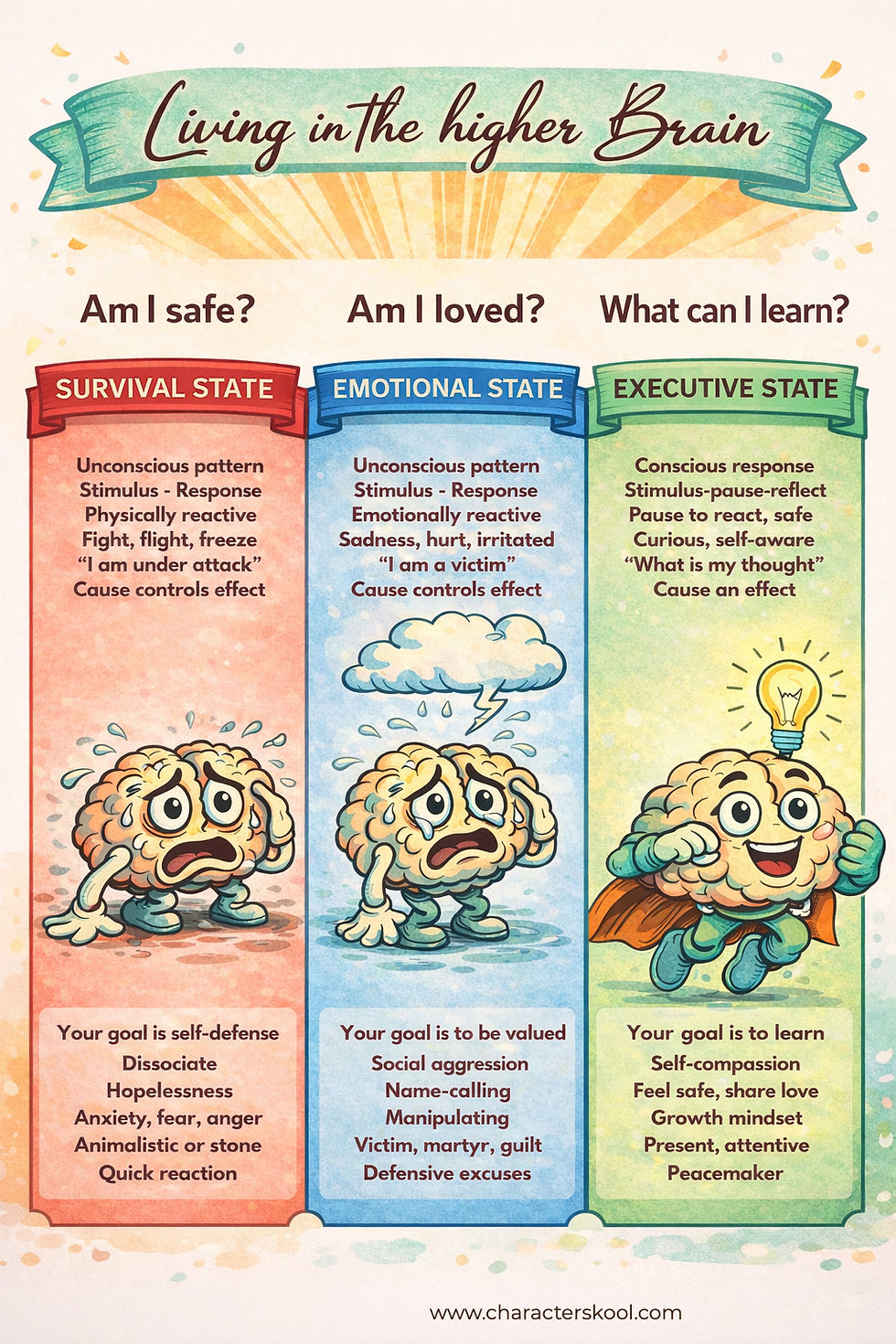
You must learn to notice the inner landscape of your mind—what state you are living from, and what quietly pulls you into different corners of thought. Sometimes you can look inside and discover it for yourself. At times, you might require the support of the most profound connections in your social network, such as a life coach, a trusted grandmother, but most especially, God.
There was a spiritual leader who was sitting in a leadership meeting, discussing mental health in teenagers. He leads a church of over 17.5 million Christians. They bring all the brilliant research of our day in to discuss how to solve many socioeconomic and spiritual problems. With the mental health that is rapidly decreasing in today's world, you would think there would be a list of 50 things that he would state would help the youth in that meeting. But when it was his turn to share a solution, he simply said, "Help them learn the truth of their identity, as beloved children of Heavenly Parents." It is that simple, and yet, the study of brain science has confirmed this simple truth. Love really is the fire starter, and Jesus loves you. You never have to question if you are loved.
3. What You Cannot Control
Life is genuinely, sometimes brutally unfair. Viktor Frankl survived Nazi concentration camps and emerged with a book read by millions. His core message: "A man cannot directly choose his circumstances, but he can choose his thoughts."
Scientist Andrew Huberman — not known for spiritual language, but rather his scientific expertise — recently said openly: when people hand the unbearable over to God, something remarkable happens. The thing that is hardest for humans to do for themselves becomes far easier when they stop trying to do it alone. "I'm 50, and for the first time in my life, I've experienced sustained, real, deep peace… 100% because of giving over to the notion of a higher power." There are amazing individuals who lead virtuous lives yet still develop diseases or cancers. It seems the old saying, "Life is not fair," rings true when you hear stories like these. The message of those who find God in adversity is that there is help bigger than you trying to hold you. I remind you of the story of Lazarus:

(I quote Charles Dickins' version:)
"There was a certain rich man who was clothed in purple and fine linen, and faired sumptuously every day. And there was a certain beggar, named Lazarus, who was laid at his gate, full of sores, and desiring to be fed with the crumbs which fell from the rich man's table. Moreover, the dogs came and licked his sores. And it came to pass that the beggar died, and was carried by Angels into Abraham's bosom; Abraham had been a very good man who lived many years before this time, and was then in Heaven. The rich man also died, and was buried. And in Hell, he lifted up his eyes, being in torments, and saw Abraham afar off, and Lazarus. And he cried and said, 'Father Abraham, have mercy on me, and send Lazarus that he may dip the tip of his finger in water and cool my tongue, for I am tormented in this flame.' But Abraham said, 'Son, remember that in thy life time thou receivest good things, and like-wise Lazarus evil things. But now, he is comforted, and thou art tormented!'"
Jesus told that story on purpose — for anyone living righteously in difficulty, wondering when relief comes. All strands of spiritual wisdom say you're inherently gifted, powerful, and worthy but you have to give yourself the fighting shot of even being able to see it.
Be still and know that I am God. -Psalm 46:10
There is a part of this world that creates resistance to God, one that tries to mix Godly truth into the pot while taking out the owner. Jesus has so much power to help you, a friend hidden in your pocket. And then there's this: Jesus experienced every category of human suffering — not in generality, but specifically. He knows the moment the brakes locked. He knows what it felt like when your mother got her diagnosis. He knows the grief of the quiet apartment, the anniversary you faced alone. "He has descended below them all." That isn't poetic language. That is the most useful thing you will ever know.
You can do hard with Jesus, or you can do hard alone. When you do hard with Jesus, the hard becomes holy. — Camille Johnson
Listen to the most beautiful revelation given to a man who ended up becoming a martyr to spread the work of Jesus Christ in the 1800's: "If thou art called to pass through tribulation; if thou art in perils among false brethren; if thou art in perils among robbers; if thou art in perils by land or by sea; If thou art accused with all manner of false accusations; if thine enemies fall upon thee; if they tear thee from the society of thy father and mother and brethren and sisters; and if with a drawn sword thine enemies tear thee from the bosom of thy wife, and of thine offspring, and thine elder son, although but six years of age, shall cling to thy garments, and shall say, My father, my father, why can’t you stay with us? O, my father, what are the men going to do with you? and if then he shall be thrust from thee by the sword, and thou be dragged to prison, and thine enemies prowl around thee like wolves for the blood of the lamb; And if thou shouldst be cast into the pit, or into the hands of murderers, and the sentence of death passed upon thee; if thou be cast into the deep; if the billowing surge conspire against thee; if fierce winds become thine enemy; if the heavens gather blackness, and all the elements combine to hedge up the way; and above all, if the very jaws of hell shall gape open the mouth wide after thee, know thou, my son, that all these things shall give thee experience, and shall be for thy good. The Son of Man hath descended below them all. Art thou greater than he?...Thy days are known, and thy years shall not be numbered less; therefore, fear not what man can do, for God shall be with you forever and ever." - J. Smith.
4. What You Can Control
For the trials we bring on ourselves — and we all do — the starting point is self-compassion.
There's a difference between guilt that guides you and guilt that imprisons you. Pain from crossing a line exists to redirect you. But the low-grade guilt of ordinary human weakness? That's the stuff to throw out. There are three main ways you can put your thoughts on trial:
Trials from feeling shame or guilt for wrongs we have committed.
Trials from feeling frustrated or defeated by our weaknesses.
Trials from attaching a negative/false thought to a neutral circumstance.
Accept your humanness. It is not if we make a mistake, it is what we do after the mistake that matters. We can not escape this human aspect of being flawed. Weakness is embedded in you to show you the portals through which you can transform. God says he gives them to us to help us be humble, but he also states that he will make weak things become strong. We all carry unnecessary amounts of guilt, some of it which serve us, and some that doesn’t.

Repentance — deeply misunderstood as punishment — literally means to breathe, change your mind, and turn back. It is a gift, not a penalty. A great secret to having emotional resilience, is knowing that you can have inner peace, even while the storms rage in your life. Knowing God's virtues that prevent pain from guilt can be pondered in this classroom here. God's laws are not there to hurt you, they are there to protect you. You have weaknesses because it is written in the package we signed up for while in this lifetime. It's comforting to realize that we're all in that together.
A method to confront the nervous mind talking during the heat of the moment is by recalling powerful phrases you keep locked up in your mind for those very instances. You can train the story in your mind during full throttle moments. Words carry and create energy and faith begins with how you talk to yourself. The world has told you that you have to be X to be loved or Y to be cool or Z to be successful. All of that outside advice that makes other people glow has pulled you out of what makes you shine. You can narrate your own power.
All the tiny doubts that creep in can be subtracted, erased, and eliminated so you can see your own magnificence becomes an actual possibility. If you want to stop shrinking, you have to speak your power into existance. The Savior Himself said he was the light and the life of the world. The great I Am. He modeled how we are to affirm ourselves. "I am worthy." "I am loveable." "I am learning."
For the doubt that quietly narrates your days — "I can't do this, I'm going to fail, I'm not enough" — Craig Manning trains elite athletes with a simple tool: power statements. Not grand declarations about the future. The next step only. "I create energy." That's it. Words are fuel. Speak your power into being. Remember, God calls people with character flaws. I love how Jenn Wiemann says it, “Job understood that kind of gratitude. He lost everything: his wealth, his health, his family, his stability, and still, he fell to the ground and worshiped. Job didn’t thank God for the pain, but he trusted God in the pain. His gratitude wasn’t rooted in outcomes; it was rooted in relationship. He knew that God’s goodness wasn’t canceled by his circumstance.”
5. Small Things Matter Enormously
I once learned that the African sand of the Sahara dessert, travels accross the Atlantic Ocean, and dusts the air of the Carribbean and South America, fertilizing the rainforests. I have friends who cough and struggle through the dusty seasons, but don't realize that the dust is bringing them healthy rainforests, which bring us healthy water and vital plants and minerals. The ecosystems of our bodies and our communities are just like that. The small things matter. "By small and simple things do great things come to pass."
If you are not already aware, you have a loving God who is beyond patient with you as you work through the small parts inside yourselves. Sometimes you learn that your physiology is just as important as psychology. Refining our tiny but mighty habits helps us build resilience. Even the simplest things, like drinking water, taking vitamins, making our bed, and setting alarm clocks, can be all the difference in life.

A luxury houseboat on Lake Powell sank because a small rubber seal — a part meant to be replaced annually, costing almost nothing — was neglected. The whole magnificent vessel, gone. During an especially wavy night in the channel, water came in, and it is estimated the motor stopped at this one tiny spot:

Your life operates the same way. Drink your water. Say your prayers. Make your bed. These things aren't small because they're simple — they're mighty because they're consistent. The compound effect is silent and relentless, working for you or against you. The power of tiny but mighty habits can be explored in this classroom here where we explore simple ways to motivate you to build your simple habits in life.

6. Confront the Dragon
Eventually, willpower and advice fall short. You must confront what's holding you back.
That's what journaling is for. As Paul warns, "For the time will come when people will not put up with sound doctrine. Instead, to suit their own desires, they will gather around them a great number of teachers to say what their itching ears want to hear. They will turn their ears away from the truth and turn aside to myths." What if our truth is already held deep within us. A break from the mind of the world is all it takes to reach it.
Writing externalizes the stories that have lived rent-free in your mind so long they convinced you they were permanent. When you name something without judgment — just with curiosity — you create distance from it. Enough so that you will see fresh angles. Inspiration will come. Across 27 expressive writing studies, 68% of interventions showed measurable reductions in anxiety and PTSD symptoms. A Cambridge meta-analysis found it comparable to clinical intervention for healthy individuals.
The Cherokee parable says it plainly:
"A fight is going on inside me between two wolves. One is evil — anger, envy, self-pity, guilt, ego. The other is good — joy, peace, love, humility, faith. The same fight goes on inside you." The grandson asked: "Which wolf wins?" "The one you feed."

Two questions worth writing at the top of every journal entry:
What's awesome about this?
What can I learn from this?
Pain is a guidance system. Sit in it. Shine a light on it. Then — release it.
Eve understood this before any of us. Leaving the garden meant pain — and also family, joy, growth, mortality, life. She chose the fullness over the safety. "It is better for us to pass through sorrow, that we may know the good from the evil."
Our brains love to generalize things, judge things, and create beliefs that are not always true. This is the thing we are here to overcome. It's our brain trying to form patterns and shape neural pathways. I quote Jody Moore, "Did you know that every single thing that happens in the world, that people say, what people feel, what they think, what they do, the weather, what's going on in the government, what's happening in the schools, what your house looks like, what you look like, every single thing happening that we would call a circumstance is neutral until we think thoughts about it...for some reason, we say things like, that triggered me, I got triggered. It's a word that comes from clinical therapy, and it can be useful at times in a therapeutic setting. But many people use it to actually disempower themselves by giving the credit to the circumstance." One of the best ways to put your thoughts on trial is by writing them all down. Your beliefs shape your thoughts. Those thoughts shape your feelings which shape your actions because your brain responds to the thoughts you create and sends signals through your body. It would not matter if you have five fancy cars in your garage, you could still be in despair all the time simply by what you believe.

Unlike a dog getting zapped by his shock collar for barking, we get to choose our beliefs, and they sometimes come with hidden costs that slowly start to damage our character. Some circumstances give us instant consequences, whether they are neutral or not. Like when you bite into a jabanero pepper. There is instant fire mouth, and no thought will change how spicy it tastes. You instantly believe, this pepper is too spicy. Some circumstances are painful in an instant, and we simply learn to think: avoid at all costs. This can be useful for survival. But some circumstances are more neutral, and our thoughts around them are false, overexaggerated in our minds. Put your thoughts on trial. Journaling is so simple, and so overlooked! At the bottom of this classroom, I have journal prompts that you can visit anytime. These journal prompts below are based off proven strategies from experts in this field of the psychology of happiness. Confront the dragon.
The joy we feel has little to do with the circumstances of our lives, and everything to do with the focus of our lives. -R. M. Nelson
The Bottom Line
Resilience isn't the loudest person in the room. It isn't white-knuckle control or an impressive list of habits (though good habits help). It's the humble, quiet, practiced ability to bend without breaking — to be stretched out into the wilderness and trust that the mercy moment is coming.
Joseph saw it. Lazarus saw it. You will too.
The one you feed wins. Feed the right wolf.
Bonus Ideas:
It is not happiness that brings us gratitude, but gratitude that brings us happiness.
We read the habits that people rave about that make them successful, like this list from Thesucesshabits page:
Responsibility always comes before freedom
Discipline matters more than motivation
Excuses slowly destroy self-respect
Life is unfair, and complaining changes nothing
Control your emotions or they will control you
Respect is earned through behavior, not demanded by force
Comfort too early creates fragility
Your word must mean something
Learn to stand alone when necessary
Work ethic outlasts talent
No one is coming to save you so become self-reliant
Respect women through actions, not words
Asking for help is wisdom, not weakness
Failure is information, not identity
Learn money discipline early
Choose long-term gain over short-term pleasure
Control impulses or live with regret
Respect time more than comfort
Never chase approval
Become dependable before becoming powerful
Okay the rest of this classroom is a journaling tool we hope you come back to often. Come back to this classroom section anytime to use the following journal prompts. All that is required is a pen and some paper and a view of the following questions we have created for you. The first one is a tool developed by Katie Byron who is known for helping people challenge and change their beliefs. Grab some paper and write while you read the questions:


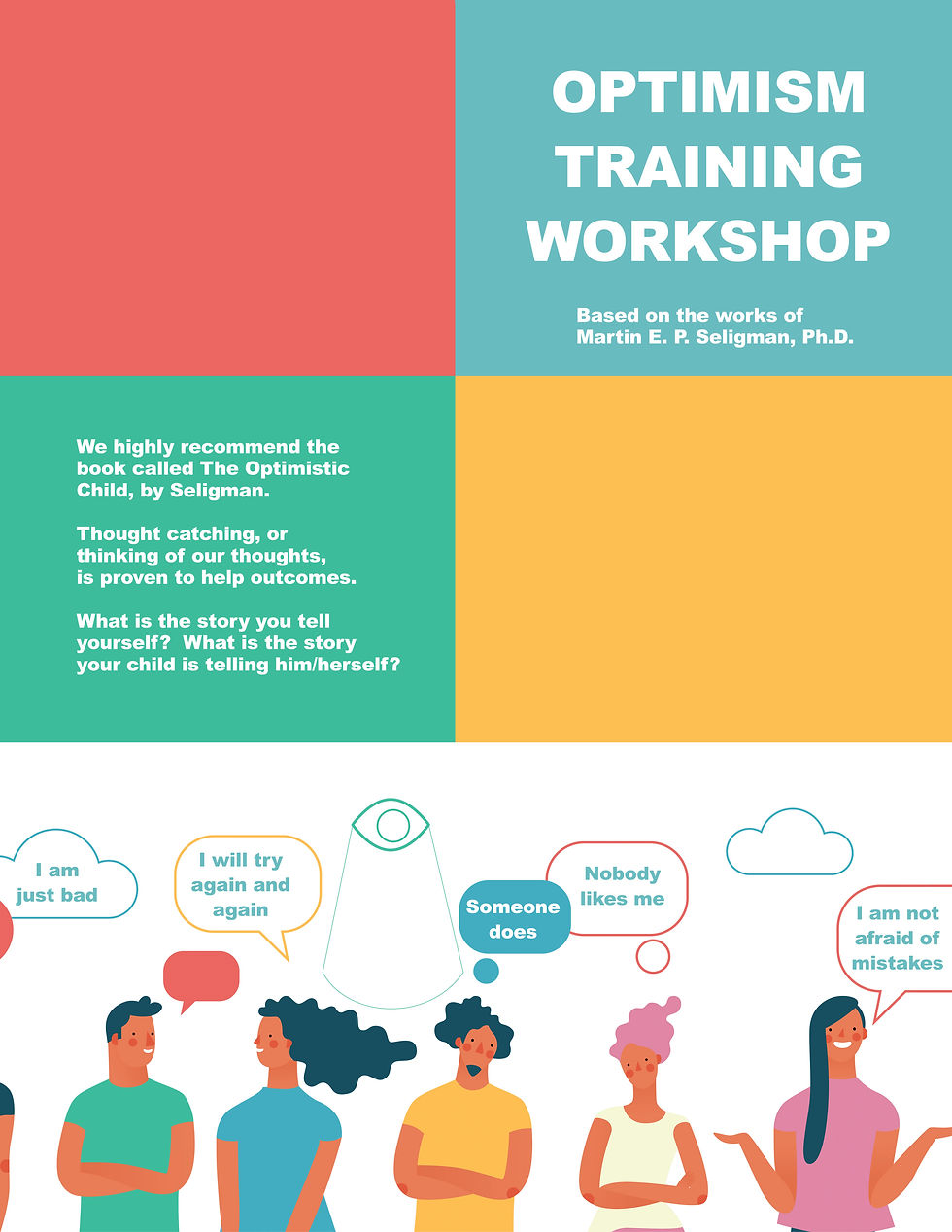
Here are some worksheets especially for kids that I created based off the beautiful work by Martin Seligman. We highly recommend that you print off these sheets and use them to help your kids, when they feel stuck. You could also just view them together right here and right now, and grab your journals, and follow the question prompts with paper. Browse through the questions, and reflect with your kids. These are great for you to mentally rehearse together as a family so you can try and use these resources when you or a family member feels stuck. Or skip to the bottom of the lesson and come back to these worksheets when you are ready.


We hope you join us in more classrooms here!


