

Self-restraint dopamine gremlins
Updated: May 8
Restraint is the ability to refrain from action in a moment of temptation... from that ice cream, that video game, Instagram scrolling, or whatever habit you have formed that seems to become a constant need in your life. Why do we go back to the same old habits and patterns all day? The answer... dopamine and the ever-constant access to instant gratification. The more you understand dopamine, the better you can confront your bad habits that shadow your life.
I want you to learn a very critical thing about your brain. Pain and pleasure are processed in the same area of your brain by the same parts of the brain. Pleasure and pain work like a balance. I know this does not sound very scientific, but it is almost like you have a teeter-totter in that part of your brain.

The teeter-totter wants to stay level. Our brains work very hard to restore balance, or what science calls "homeostasis." When you watch a really good TV show that you just can't stop watching every day, you may feel the pleasure side of the teeter-totter go down. This is all that rushing dopamine making you feel content to sit and do whatever you are doing.
Here is the problem with the teeter-totter in your brain. It really can't stay down on the pleasure side, and it can not just go back to balance. If you step down hard on the pleasure side, then the little gremlins of pain will step in and go extra hard down on the other side of the teeter-totter for longer. You can't just all the sudden go back to balance after pleasure. Scientists call this the inability to go back to homeostasis. Your brain will push down on the pain side for a long time after a dose of pleasure. And if you pushed really hard on the pleasure side, then your brain will push really hard on the pain side.
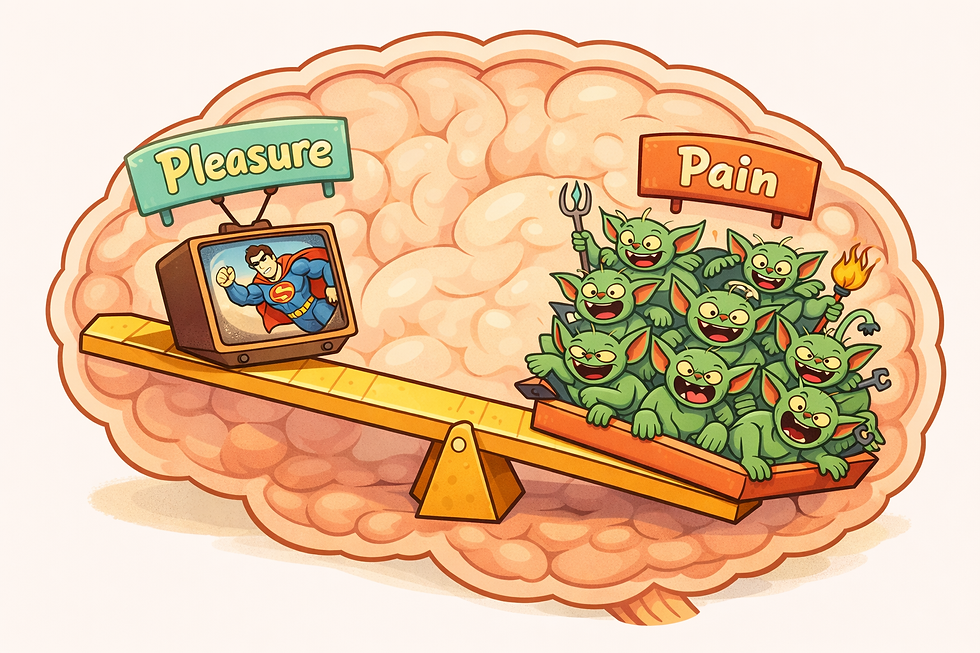
These pain gremlins are a way that Dr. Anna Lembke help us understand in a friendly way how dopamine balance cannot be restored after too much pleasure. No pleasure comes without a cost. The gremlins like being on the teeter-totter. This is the after-effect, or hang over. If you turn off the TV after one show, or hop off the Nintendo after 20 minutes, and you spend the rest of the day working in the garden, doing homework, or helping mom with the dishes, the gremlins will hop off the balance. But if you don't wait long enough, you end up with enough gremlins to fill a whole room. You have changed your hedonic setpoint. A hedonic setpoint is your individual, genetically-influenced baseline level of happiness or well-being that you tend to return to over time, despite major positive or negative life events. It is your happiness balance level. If you don't allow the pain gremlins to balance the scale, and you keep pushing on the pleasure side, you are experiencing an addicted brain. You can't feel normal without way more pleasure than you use to.
Interestingly, if you hop on the pain side first, the opposite happens! You will feel a great sense of satisfaction after enduring pain initially. This is why tackling difficult tasks first in life is often the most rewarding. It's the reason you might feel exhilarated after a high-energy basketball game or after an intense morning weightlifting session. This is why we recommend quick, painful ice baths before you sit down to do work at the computer, or go do all your chores before you hang out with friends. When you do painful things first, you feel the reward of joy after. You avoid addiction and you gain character, resilience, respect, and self-discipline!
Do the hard things first and life will become easier. Do the easy things first, and life will eventually become harder.
We have all learned that TV shows are a great example of something that can be hard to hop off. We all have seen how they leave you not knowing the ending, so you want to keep watching the next episode. Before you realize it, seven hours might slip away. The same goes for addictive gaming apps, unhealthy books, sugary desserts, and pinterest scrolling. What do these things have in common? Instant gratification! The problem is, those pain gremlins will not let you have all the dopamine you want without a cost. If you can remember one thing, remember that pain is a guidance system. You want to know who told me that? God! One night, in the middle of the night, I was talking to Him about a painful moment I was having. He told me that pain is a guidance system. To make a long story short, I'll say this...I learned that I am to embrace what is causing me pain and learn from it before I can get rid of it. It is there to teach me something. Those pain gremlins are actuallly your friends.

I heard a famous singer named Jewel once say that she grew up singing songs with her family in bars in Alaska. They did not come from money, and everyone had to participate to help. She was a young little girl, having to watch men and women live their lives drinking alcohol. She said she noticed that they were all there to hide or run from some pain in their life. They were essentially trying to numb their pain. She said she learned to look at her own pain, by writing about it, talking to it, and facing it on paper because she didn't want to run from it like the people she watched in the bar. I thought that was a profound thought from someone who didn't have much else to see at such a young age. Even her own father struggled with alcoholism. In various interviews and her bestselling memoir Never Broken, she has emphasized that she consciously avoided alcohol and drugs, due in part to the high chances of her life "being disastrous" given her upbringing. She has instead focused on mental health, mindfulness, and self-healing to process her past trauma. She has even developed a business, Jewel Inc., to share these mindfulness tools with others. Jewel has stated that she never drank alcohol or did drugs in her life. She grew up with a father who was an abusive alcoholic and suffered from PTSD, and she has spoken openly about her challenging childhood and the poverty she experienced. Observing her father's battles with substance abuse significantly shaped her decisions, yet she also learned early on how to handle pain without resorting to numbing it. Pain truly is a guidance system. The more you try and numb it, the more it tries to linger.

Dopamine is a chemical in your brain that makes you feel happy, excited, or motivated when you do something fun or rewarding. It’s like your brain’s “feel-good messenger.”
What’s Good About Dopamine:
Motivates you: Helps you get things done, like homework or sports, because your brain feels rewarded when you finish.
Makes learning fun: When you solve a problem or learn something new, dopamine gives you a little “yay!” feeling.
Rewards healthy habits: Eating healthy, exercising, or practicing a skill gives you dopamine, which encourages you to keep doing good things.
What’s Bad About Too Much Dopamine:
Addictive behaviors: Too much dopamine from junk food, video games, or social media can make your brain want more and more, even if it’s not healthy.
Hard to focus: Constantly chasing quick dopamine hits can make it harder to concentrate on school or long-term goals.
Mood swings: Relying only on dopamine “rewards” can make you feel sad or bored when you don’t get them.
How to Manage Dopamine:
Balance fun and work: Reward yourself after finishing tasks instead of always seeking instant fun.
Do healthy activities: Exercise, hobbies, and learning new things give steady dopamine without causing problems. Learning is good dopamine!
Take breaks from screens: Too much gaming or social media can overstimulate dopamine, so mix in offline time. Go into nature!
Set small goals: Completing small tasks gives you little dopamine boosts and keeps motivation steady. Set small goals, not goals that are too far out there.
Dopamine is like a brain cheerleader. It cheers you on when you do good things, but if you let it only cheer for addictive entertainment, it can trick you into bad habits.

Here is a great summary of what I taught, by Anne Lembke's book. The following video is life-changing information, however, I caution your family to be aware of one thing in this video. The video is created with art drawings and there is one spot at the beginning, and a few minutes in, where you can see a tiny cartoon drawing of a TV with a naked lady sketch on it for a few seconds. This is because she is talking about addiction, of which porn is rightfully in that category. The video only shows that for a few seconds but since it is a cartoon and it is not the only addictive thing that is drawn, your kids may even miss it. The first one at the beginning is subtle, but the second image a few minutes in I would say is not appropriate for younger boys to see. Because this message is so important and so powerful, and the image shows for only a few seconds of the video, and it is not the focus of the video, I recommend, if you can, to still watch this video. There is no other images to be concerned about. Maybe shield your sons eyes when the cartoon appears. Otherwise, you can skip the video, or just watch the first few minutes! This information is so powerful, so either way, I hope you take the time to learn this important lesson.
Real talk — self-discipline learned early doesn't just fix one bad habit. It can literally shape your whole life's trajectory. The Dunedin Study (scientists who followed people for years like the world's least exciting reality show) found that kids with better self-control just... ended up doing better at life. Across the board. And here's where people get it wrong — self-discipline isn't about gritting your teeth and suffering through things. It's about working smart. Scientists studied how students prep for the SAT and found that kids who used actual strategies — planning study sessions, building routines, creating systems — outscored the kids who just tried to force themselves to focus. Willpower alone is overrated. Systems win.
Focus on the process, not the outcome.
Then there's the famous marshmallow experiment. Scientists put a treat in front of little kids and said: eat it now, or wait, and get two. The kids who waited? They ended up with higher achievement scores and better self-regulation years later. Basically, the ability to say "not yet" to small rewards for bigger ones is one of the most powerful skills you can develop. (Scientists later found that trust and environment also play a role — so it's not just about willpower, which is actually good news.) The deeper question is this: do you trust that choosing discipline now sets up a better reward later — whether that's in this life, or the next? Because every time you delay the marshmallow, you're betting on yourself. This is called opportunity cost. Opportunity cost is the potential benefit, profit, or value of the next-best alternative that is given up when making a choice. It represents the hidden cost of choosing one option over another, highlighting that every decision involves a trade-off due to limited resources like time, money, or capacity.
Understand natural laws & the blessing attached:
Here's something nobody talks about — blessings are often just laws you haven't connected the dots on yet. Like, there's literally a pattern: obey the principle, receive the reward attached to it. It sounds old-fashioned until you see the data. Obedience has a cheat code most people don't know about.
If you practice the standards your church sets, science actually has some things to say about that lifestyle:
Crime? 99.7% of 237 academic studies found that religion lowered or had a neutral effect on crime. Nearly unanimous. And highly religious areas may see up to 81% less crime. That's not a small number — that's a different world.
Hard times hit different when you have faith. Religious people may be 166% more satisfied during unemployment than non-religious people. Losing a job is brutal for everyone — but apparently, faith changes how much it wrecks you.
Mental health. Religious people may be anywhere from 3 to 33 times less likely to commit suicide. Studies also suggest better resilience against depression, anxiety, addiction, and general life chaos. That's a staggering gap.
Physical health too. One study found religious people may have better physical functioning, stronger resistance to disease, and healthier habits overall. Your faith might literally be adding years to your life.
And here's the wildest part — the laws God gave the Jewish people thousands of years ago have repeatedly turned out to be medically and scientifically ahead of their time. Things written before modern science existed that scientists are still catching up to. (Tetlow 2005)
So when God or your church asks you to live by a certain standard, it might be worth asking — what blessing is attached to this law that I haven't discovered yet?
If you want to learn more about how studying the blessings behind the law can help build your self-discipline, motivation, and desire to live with high standards and character, then visit this classroom here!
What if the pain gremlins in your brain are there by divine design? What if guilt is placed in all of us to guide us back into God's path? What if pain really is a guidance system? I ran into these scriptures from the ancient American scriptures and yes, this is deep, but very profound:
"Now, repentance could not come unto men except there were a punishment, which also was eternal as the life of the soul should be, affixed opposite to the plan of happiness, which was as eternal also as the life of the soul. Now, how could a man repent except he should sin? How could he sin if there was no law? How could there be a law save there was a punishment? Now, there was a punishment affixed, and a just law given, which brought remorse of conscience unto man. Now, if there was no law given—if a man murdered he should die—would he be afraid he would die if he should murder? And also, if there was no law given against sin men would not be afraid to sin. And if there was no law given, if men sinned what could justice do, or mercy either, for they would have no claim upon the creature? But there is a law given, and a punishment affixed, and a repentance granted; which repentance, mercy claimeth; otherwise, justice claimeth the creature and executeth the law, and the law inflicteth the punishment; if not so, the works of justice would be destroyed, and God would cease to be God. But God ceaseth not to be God, and mercy claimeth the penitent, and mercy cometh because of the atonement; and the atonement bringeth to pass the resurrection of the dead; and the resurrection of the dead bringeth back men into the presence of God; and thus they are restored into his presence, to be judged according to their works, according to the law and justice." Alma 42: 16-23
My interpretation is that when we come to earth, the bodies that God gave us are given ways to detect when we are in the wrong path or the wrong habit through those tiny chemicals that scientists love to study. Oxytocin, dopamine, adrenaline, etc. They all serve a purpose in making us human, but they also serve a purpose in guiding us when we are choosing actions that don't follow the laws of heaven. Guilt can be a guidance system. Maybe it is all connected to what the scriptures call "the light of Christ." God loves you, and he is trying to help you gain eternal joy, and he is patient as you learn here on Earth how to manage your humanness, your chemical-filled bodies, your imperfect emotions, the one that teaches you so many important things. True joy is a combination of spirit and body working in alignment with God's laws, that make up our soul.
Know your identity and purpose:
Another way you can build your self-discipline is simply by focusing on being intentional on following your values. Being intentional means you act with a thought that has a purpose. Do you feel like you have a purpose in life? We receive the blessing of self-control, simply by intentionally thinking about our life's purpose. We say no to the things that are not guiding us in our purpose, and we say yes to the things that help us live our higher identity. Visit this classroom here on finding your life's purpose, gifts, and identity. Visit here to discovering your True North and your values. Both of these classrooms will help you discover your identity and purpose.

Begin with the end in mind:
One more way you can build your self-discipline is by beginning with the end in mind. What is the result that you want in five year? Twenty years? The next life? Visit this classroom here to discover the art of creating your future through intentional vision. There is a whole lot of science behind this!

Day by day, hour by hour, man builds the character that will determine his place and standing among his associates throughout the ages. … More important than riches, more enduring than fame, more precious than happiness is the possession of a noble character. Truly it has been said that the grand aim of man’s creation is the development of a grand character, and grand character is by its very nature the product of a probationary discipline -David O. Mcckay
Do you believe you can create your future through self-discipline? Really the discipline is just staying aligned with natural laws that even the heavens obey, and by following those natural laws we gain eternal blessings. The laws stop appearing like "commands" and become a recipe for joy and the hope of a glorious future.

Story Recommendation for Kids:
A story about Dandy the horse


